Where is Forbidden City?
Forbidden City is in Beijing, China, in Asia. The game uses the reference point shown below: 39.9163°, 116.3972°. A guess within 25 km earns the full distance score before any hint deduction.
The marker represents the central Forbidden City complex in Beijing. The property includes many halls; the game uses a city-level distance tolerance for those nearby photographic viewpoints.
Map loading. Coordinates: 39.9163°, 116.3972°.
The story behind the landmark
The Ming emperor Yongle commissioned the palace, built between 1406 and 1420. It became a centre of imperial government and residence for the Ming and Qing dynasties. Its arrangement distinguishes the ceremonial outer court from the more private inner court, giving the complex a clear spatial hierarchy.
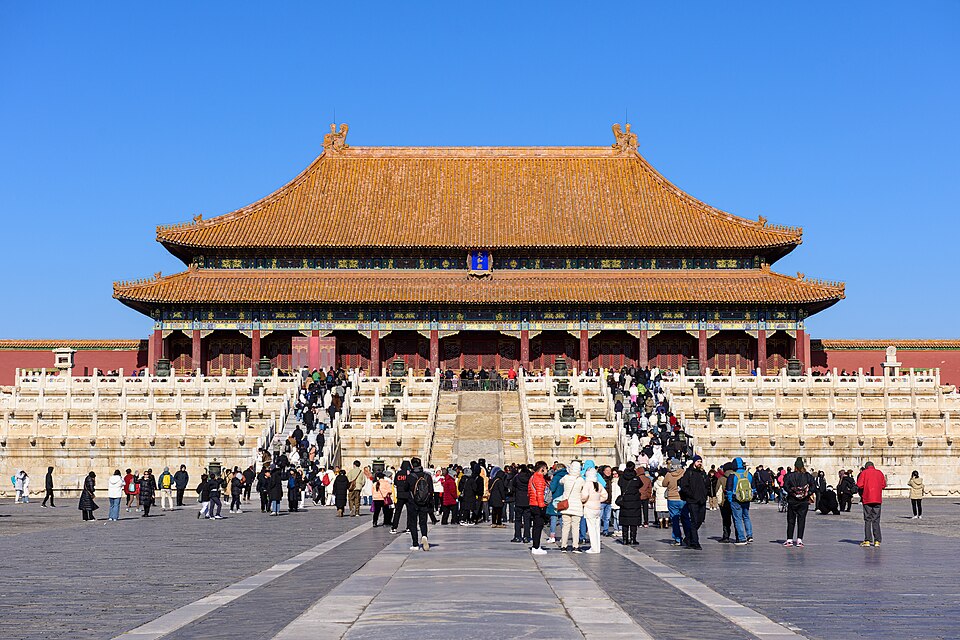
The Palace Museum was established in 1925 within the former imperial residence. Beijing's municipal description highlights the enclosing walls, surrounding moat and four gateways. The yellow roofs and vermilion walls visible in photographs are therefore parts of a much larger palace environment, rather than the façade of a single building.
How to recognise it
- Yellow glazed roofs above vermilion walls
- A sequence of large halls and open courtyards on a straight axis
- Carved pale-stone terraces and balustrades around major halls
Look twice: a useful comparison
Many Chinese palaces use red walls and yellow roofs. Look for the extensive symmetrical court layout before choosing the Forbidden City. Tiananmen is a separate gate south of the palace complex; a photograph of that gate should not be treated as an interchangeable image of every palace hall.
A detail worth remembering
A palace can become a museum without losing its architectural meaning. Since 1925, the Forbidden City has housed the Palace Museum, allowing the former spaces of imperial court life to be understood alongside collections of art and historical objects.