Where is Luxor Temple?
Luxor Temple is in Luxor, Egypt, in Africa. The game uses the reference point shown below: 25.6995°, 32.6391°. A guess within 25 km earns the full distance score before any hint deduction.
The reference point is Luxor Temple beside the Nile in the city centre, south of the separate Karnak complex.
Map loading. Coordinates: 25.6995°, 32.6391°.
The story behind the landmark
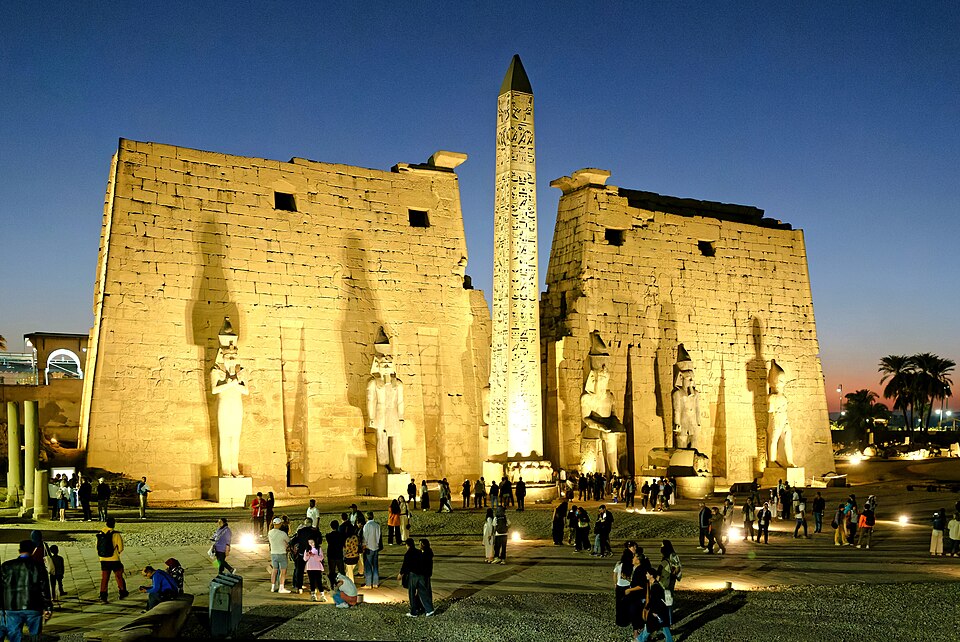
Amenhotep III built the temple’s core in the fourteenth century BCE. Later rulers continued its decoration and enlargement. Ramesses II added a courtyard and monumental entrance gateway, accompanied by royal statues and two obelisks. Only one of that pair remains at the temple; the other was moved to Paris.
Luxor Temple was connected to Karnak by a processional route lined with sphinxes. During the Opet Festival, divine images travelled between the sanctuaries. This relationship explains why the temple’s orientation follows its connection with Karnak rather than the east–west layout common to many Egyptian temples.
How to recognise it
- A broad twin-towered gateway is fronted by colossal royal statues.
- One tall obelisk stands at the main entrance.
- The great colonnade has two parallel rows of tall columns.
Look twice: a useful comparison
Do not label every Luxor photograph as Karnak. Luxor Temple’s entrance with its single remaining obelisk and the more orderly great colonnade are useful distinctions. Karnak’s famous hypostyle hall is a much denser arrangement of columns, so compare the layout before guessing.
A detail worth remembering
The entrance once had two obelisks. One has stood at the Place de la Concorde in Paris since 1836. Remembering the separated pair explains both the asymmetry in a modern entrance photograph and the Egyptian monument seen in a very different city.