Where is Eiffel Tower?
Eiffel Tower is in Paris, France, in Europe. The game uses the reference point shown below: 48.8584°, 2.2945°. A guess within 25 km earns the full distance score before any hint deduction.
The reference pin marks the original tower on the Champ de Mars, not an Eiffel-style replica.
Map loading. Coordinates: 48.8584°, 2.2945°.
The story behind the landmark
Built for the Paris world exhibition of 1889, the tower demonstrated what a very tall iron structure could achieve. Work began in January 1887 and finished in March 1889. Thousands of prefabricated pieces were assembled with rivets, turning the metal framework itself into the monument’s defining feature.
The tower was intended to have a limited initial lifespan. Gustave Eiffel encouraged experiments in meteorology, physics and communications to establish its usefulness beyond the exhibition. Its role as a support for wireless transmission helped preserve a structure that had originally been expected to disappear after twenty years.
How to recognise it
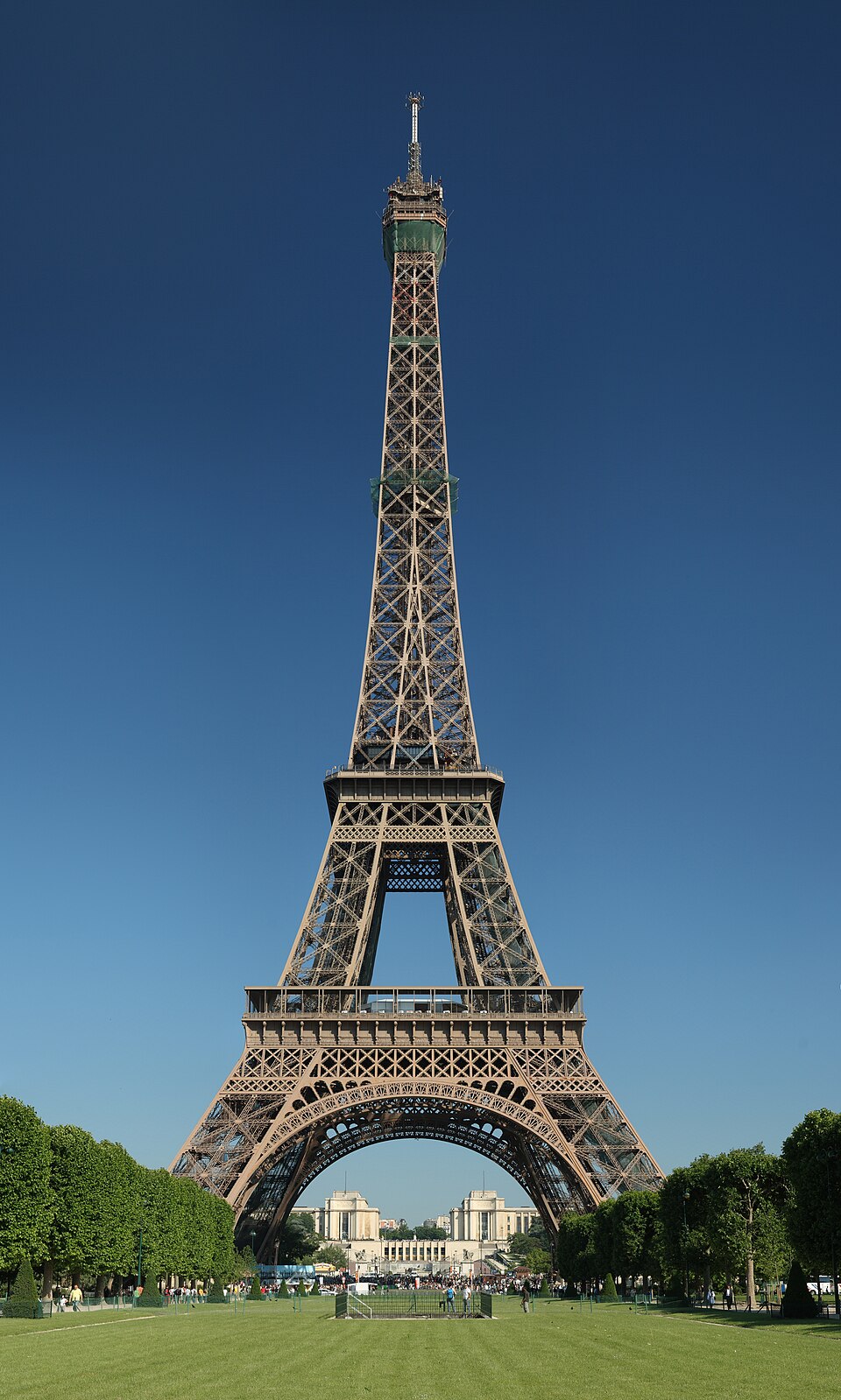
- Four widely spaced legs curve inward toward a narrow upper tower.
- Diagonal iron braces form repeated open triangles.
- Broad observation platforms interrupt the tapering silhouette.
Look twice: a useful comparison
Several cities have Eiffel-inspired towers. Look beyond the outline: the surrounding park, the scale of the base and the arrangement of the platforms matter. A lattice tower alone is insufficient evidence that the photograph shows the original in Paris.
A detail worth remembering
Scientific use helped change the tower’s future. Instead of surviving only as an exhibition attraction, it became a platform for experiments and wireless communications. The structure’s practical value supported the survival of what is now an unmistakable Paris landmark.